Magic Angle Sculptures
Make Riverside Debut
Exhibition underway at
Riverside Arts Center
RIVERSIDE, IL -- When you hold a spoon to a light, it won’t cast the shadow of a fork. Intuitively, we know that a shadow is supposed to take the shape of its “owner.” John V. Muntean’s Magic Angle Sculptures seem to break this rule. Muntean’s unique shadow-casting sculptures are currently on display at the Riverside Arts Center (RAC), 32 E. Quincy Road. The exhibition will run through October 10, 2008. Watch the video above to see highlights from the opening reception. Muntean will host a lecture entitled "The Philosophy and Science of Magic Angle Sculpture" in the gallery on Friday, October 3 at 7:00 p.m.
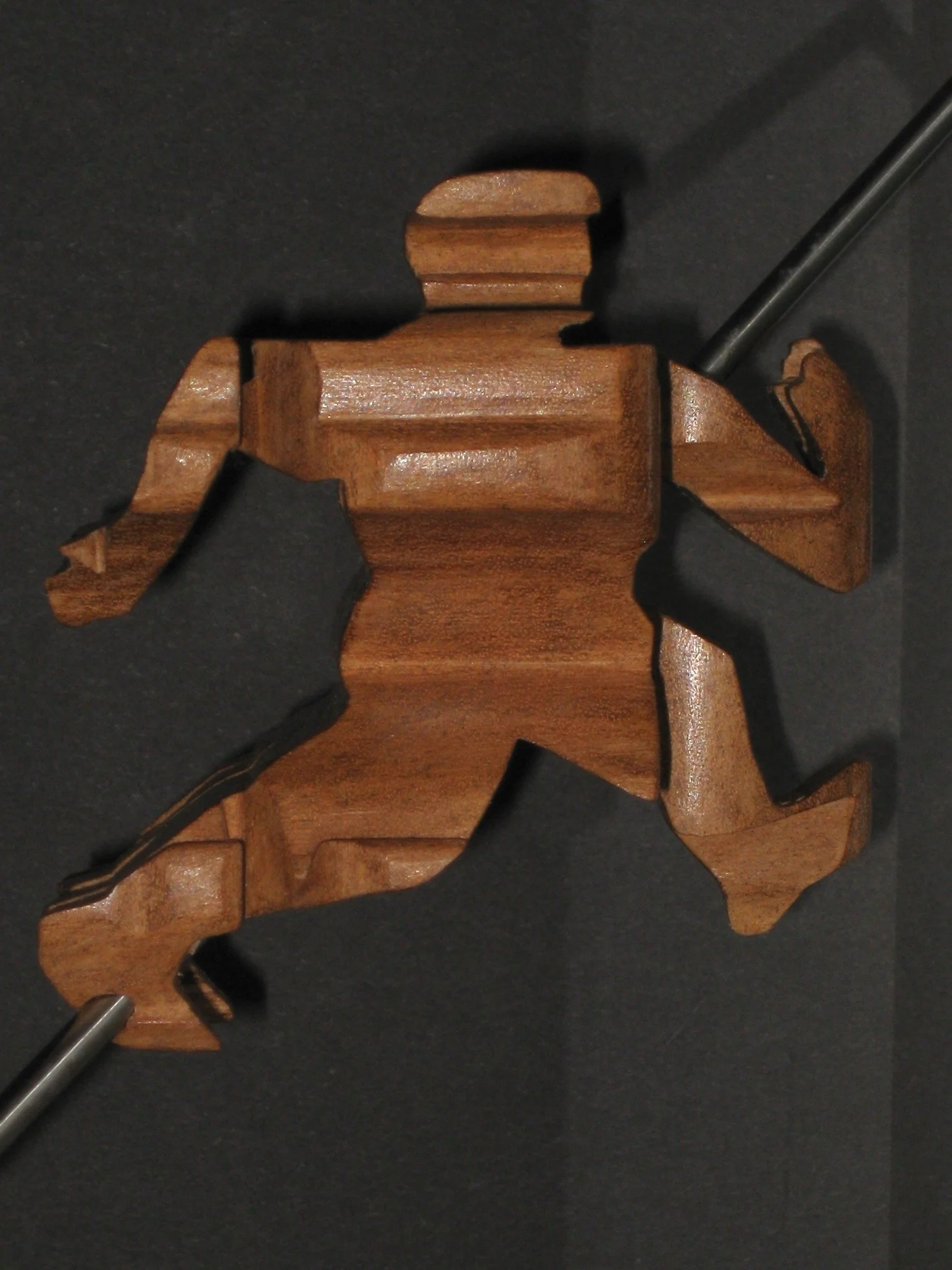
At first glance, a Magic Angle Sculpture appears to be nothing more than a finely-polished, abstract wooden carving, skewered with a steel rod and mounted on a base. The magic, however, is lurking in the shadows. When light is focused on a Magic Angle Sculpture, the apparently formless three-dimensional carving will project a recognizable shape below. When rotated on the steel rod, each sculpture projects three distinct shadows. One sculpture reveals the shadows of a man, woman, and baby; another projects a horse, elephant, and coyote. Muntean has unveiled eleven different Magic Angle Sculptures for his exhibition at the RAC.
“The objects in this show appear to be abstract when viewed as three-dimensional pieces,” says Muntean. “The true meaning is only fully revealed on a two-dimensional plane. Our eyes view the world as flat. Perspective, foreshortening and parallax allow our brains to assemble a three-dimensional representation of the world based upon two simultaneous flat images. Painters use perspective and foreshortening to convey three-dimensional space. Sculptors rely upon the viewers’ perception to interpret the object. Most objects we view have a coherent continuous set of flat images when viewed from subtly varied angles. A cow looks like a cow in profile, head on, from above, and at every angle in between. The Magic Angle Sculptures surprise us by playing with our expectations about how we view the world.”
Muntean was inspired to create the Magic Angle Sculptures through his work with magic angle sample spinning, a scientific technique that mechanically simulates a molecule tumbling through space. The effect is to rapidly interchange the three axes of the Cartesian coordinates (x, y, and z). A complex observable phenomenon in three-dimensional space (such as the nuclear magnetic moments of a static molecule) can be represented by 3 x 3 tensors or sets of 9 numbers; spinning at the magic angle simplifies that quantity to single isotropic values. Likewise, Muntean’s sculptures rotate at the same magic angle, 54.74 degrees. Every 120 degrees of rotation, the amorphous shadows evolve into three independent and identifiable forms.
John V. Muntean has a Ph.D. in Chemistry from the University of Chicago, a B.S. from Trinity College, Hartford CT, and is a high school dropout. His 1990 thesis, Quantitative Aspects of Solid-State Carbon-13 Nuclear Magnetic Resonance Spectroscopy, led to Magic Angle Sculptures. He has been a research scientist for the Department of Energy and private industry and Professor of Organic Chemistry. He is currently a spectroscopist at Argonne National Laboratory. He lives in Riverside with his wife, daughter, son, and a Westie. The Riverside Arts Center show is his first.
For more information, call the Riverside Arts Center at (708) 442-6400 or contact Muntean directly: john@jvmuntean.com
###